Can Christians Be Partisan?
A Nuanced Exploration

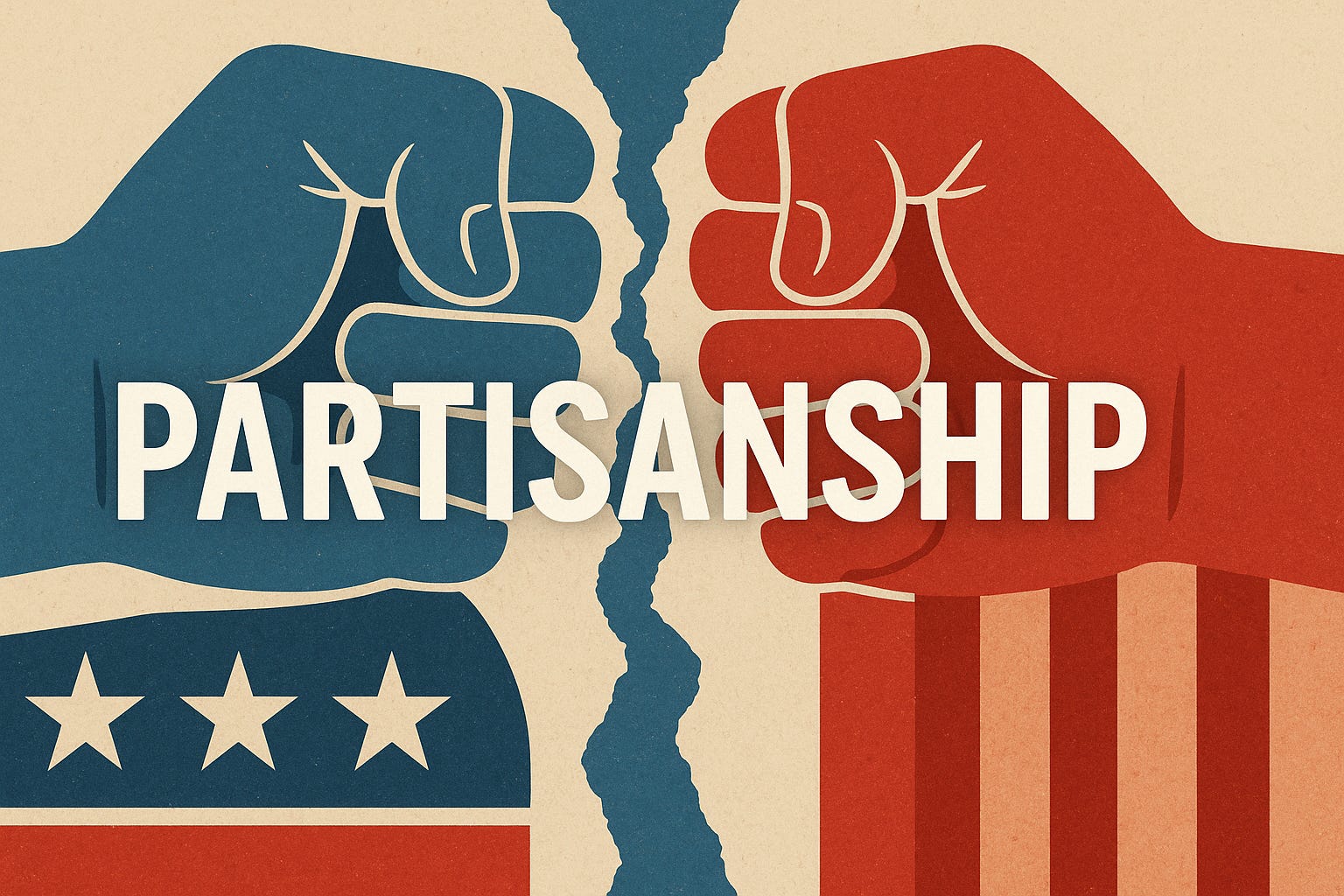
I remember the first time I realized that my faith and my politics didn’t fit neatly into any one party platform. It was a slow awakening, a gradual unraveling of assumptions I hadn’t even known I’d been harboring. As I studied Scripture and wrestled with the complexities of the issues facing our world, I found myself at times uncomfortable with the partisan rhetoric on both sides of the aisle.
And so I began to ask the question that would come to shape much of my journey: Can Christians be partisan?
The answer, I believe, is yes, and it’s incredibly complicated.
The Perils of Partisanship
At its core, partisanship is about loyalty to a particular political party or ideology. It’s about aligning ourselves with a team and defending that team against all critics. And while there’s nothing inherently wrong with having political convictions, partisanship becomes problematic when it eclipses our primary identity in Christ.
When we baptize any political party as “God’s party,” we risk making an idol out of a human institution. We start to conflate our preferred policies with the gospel itself. We become blind to the validity in opposing viewpoints and quick to demonize those on the other side of the aisle.
But the truth is, no political party has a monopoly on biblical values. No platform perfectly embodies the ethics of the Kingdom. And when we tie our faith too tightly to any one partisan ideology, we risk compromising our prophetic witness.
Biblical Tensions
Of course, this is nothing new. Throughout Scripture, we see God’s people navigating political tensions in a fallen world. In the Old Testament, we see God working through pagan rulers like Cyrus to accomplish his purposes (Isaiah 45). We see prophets like Daniel serving in the courts of Babylonian kings while still maintaining their distinct Jewish identity.
In the New Testament, we see Jesus both affirming and subverting political authorities. He pays taxes to Caesar (Matthew 22:21) but also challenges the oppressive power structures of his day. Paul instructs the early church to submit to governing authorities (Romans 13), but he also subverts the imperial cult by proclaiming Christ as the true Lord.
Again and again, Scripture resists easy categorization. It affirms the necessity of government while also relativizing its ultimacy. It calls us to seek the welfare of the city (Jeremiah 29:7) while also reminding us that our citizenship is in heaven (Philippians 3:20).
As Christians, we are called to live in this tension, to engage politically but not be defined by partisanship.
The Necessity of Discernment
So how do we do this? How do we navigate the complexities of political engagement while still maintaining our distinct Christian witness?
It starts, I believe, with robust political theology, that is a deep understanding of how our faith shapes our approach to public life. We need to be students of Scripture, immersing ourselves in the grand story of God’s redemptive work in the world. We need to grapple with the biblical themes of justice, mercy, and humble service that transcend any one political platform.
This kind of theological grounding enables us to engage in politics with discernment, not just blind loyalty. It gives us the wisdom to affirm the good in various political perspectives while also critiquing their limitations. It empowers us to advocate for policies that align with biblical values, even if they don’t fit neatly into any one party’s agenda.
In short, political discernment requires us to hold tensions, not resolve them prematurely. It invites us to practice what “holy nuance.”
Practicing Holy Nuance
Holy nuance is the art of resisting false binaries and easy answers. It’s the willingness to live in the messy middle, to affirm paradox and mystery. And in our soundbite political culture, it’s a desperately needed skill.
Practically, holy nuance looks like being able to affirm the dignity of the unborn and the value of women’s health. It looks like advocating for racial justice while also condemning riots and looting. It looks like caring for both the immigrant and the American worker displaced by shifting economic realities.
Holy nuance means we can strongly critique a policy proposal from one party without automatically endorsing the opposing party’s platform. It means we can find common ground even with those with whom we disagree, recognizing that political opponents can sometimes be unwitting allies.
Above all, holy nuance flows from the humility of knowing that our political convictions, however passionately held, are not the gospel. It reminds us to hold our views with open hands, always ready to learn from others and be corrected by Scripture and the Spirit.
The Danger of Misplaced Allegiance
Now, none of this is to say that Christians shouldn’t be politically engaged. We can and should vote, support candidates, advocate for issues, and even have party preferences. Civic engagement is part of our calling to love our neighbors and seek the welfare of our cities.
However, we must be vigilant about where we place our ultimate loyalty. This is a temptation I know all too well. In the heat of political moments, it’s easy to get swept up in partisan fervor - to start seeing the world primarily through the lens of our side versus theirs. Slowly, subtly, our party loyalties can start to eclipse our primary identity in Christ.
But as Christians, our allegiance must belong to Jesus and his Kingdom first and foremost. Our true family is not defined by party registration or national boundaries, but by our shared life in Christ. As Paul reminds the Galatians, “There is neither Jew nor Greek, there is neither slave nor free, there is no male and female, for you are all one in Christ Jesus” (3:28).
This is a radically inclusive vision that challenges all earthly divisions and factions. It relativizes every other loyalty and identity marker. And it calls us to resist the pull of partisanship when it conflicts with our Kingdom citizenship.
Of course, this is easier said than done. We are deeply shaped by our social locations and group identities. Even when we think we’re being objective, our partisan loyalties often color our perceptions and priorities in ways we don’t fully recognize.
That’s why we need the regular reminder to examine our allegiances in light of the cross. We need to be on guard against the subtle pull to pledge our ultimate loyalty to any person or party other than Jesus. And we need to be willing to critique our own side and affirm the good in others when our Kingdom values demand it.
Practicing Humility and Charity
Of course, holy nuance is easier preached than practiced. In the heat of political debate, it’s all too easy to slip into partisan talking points and demonizing rhetoric. We need the Spirit’s help to cultivate the virtues of humility, charity, and wisdom in our political lives.
Humility reminds us to hold our convictions lightly, recognizing that we could be wrong. It invites us to learn from those who see things differently, acknowledging that no one has a monopoly on truth. And it frees us from the need to score partisan points or win every argument.
Charitable discourse, meanwhile, calls us to engage political opponents with respect and grace. It challenges us to assume the best in others, even when we disagree passionately. It means treating rival partisans not as enemies to be vanquished, but as neighbors to be loved.
In my own journey, I’ve been convicted many times of my lack of charity in political conversations. I’ve had to repent of knee-jerk judgments and learn to listen more than I speak. And I’ve been humbled to discover unexpected wisdom in traditions different from my own.
Ultimately, humility and charity flow from the cross, the great leveler that reminds us of our shared brokenness and need for grace.
The Cross as Our Political North Star
And that brings us to the heart of the matter: the politics of the cross.
At its core, the cross is a subversion of worldly power and partisan division. It’s a profound challenge to the notion that might makes right or that victory is gained through dominance. Instead, the cross reveals a God who triumphs through self-sacrificial love, a King who lays down his life for both friends and enemies.
When we center our political engagement on the cross, everything changes. We no longer see power as something to be grasped, but as a tool for humble service. We no longer treat opponents as obstacles to overcome, but as people to love, even at great cost.
A cruciform politic challenges us to set aside partisan loyalties for the sake of a higher allegiance. It calls us to speak prophetic words that disrupt the status quo and imagine alternative futures. It invites us to seek the common good through self-sacrifice, not self-interest.
Of course, this is not a call to political disengagement. The cross is not an escape from the complexities of this world, but a summons to dive more deeply into its pain and possibility. It’s a reminder that our ultimate hope is not in any earthly government or policy, but in the coming Kingdom of God.
And so, dear church, let us hold our partisan identities loosely. Let us refuse to be co-opted by any earthly agenda, even as we work for justice and human flourishing. Let us engage the political realm with conviction and nuance, boldness and humility.
Above all, let us cling to the cross as our true political north star, the lens through which we interpret the world and our place in it.
Can Christians be partisan? Yes, but only in service of a higher love and loyalty.
In the name of the One who subverts all earthly power and calls us to a better way, may it be so.
Such a great article! I've lost count of how many times, when I critique my own conservative tribe, I get accused of sounding like a Democrat, or asked, "Would you prefer Hillary to have won?" Just because the GOP has (often inconsistently) promoted some issues precious to Bible-believing Christians, some people take that as meaning they are "God's Own Party" and everything they put forth must have divine approval.
Darrell Bock's book "How Would Jesus Vote?" is a great resource for seeing how on some issues, people on both the left and right have some scriptural support for their policy proposals. Both may be working from a biblical goal, and just disagree on the best practical way to reach it.